banner-nihlogo.png

For Immediate Release: Friday, October 17, 2014

Rapid agent restores pleasure-seeking ahead of other antidepressant action

Depression deconstructed — NIH study

A drug being studied as a fast-acting mood-lifter restored pleasure-seeking behavior independent of — and ahead of — its other antidepressant effects, in a National Institutes of Health trial. Within 40 minutes after a single infusion of ketamine, treatment-resistant depressed bipolar disorderpatients experienced a reversal of a key symptom — loss of interest in pleasurable activities — which lasted up to 14 days. Brain scans traced the agent’s action to boosted activity in areas at the front and deep in the right hemisphere of the brain.

PET scans revealed that ketamine rapidly restored bipolar depressed patients’ ability to anticipate pleasurable experiences by boosting activity in the dorsal anterior cingulate cortex (yellow) and related circuitry. Picture shows PET scan data superimposed on anatomical MRI image.
“Our findings help to deconstruct what has traditionally been lumped together as depression,” explained Carlos Zarate, M.D., of the NIH’s National Institute of Mental Health. “We break out a component that responds uniquely to a treatment that works through different brain systems than conventional antidepressants — and link that response to different circuitry than other depression symptoms.”

This approach is consistent with the NIMH’s Research Domain Criteria project, which calls for the study of functions – such as the ability to seek out and experience rewards – and their related brain systems that may identify subgroups of patients in one or multiple disorder categories. Zarate and colleagues reported on their findings Oct. 14, 2014 in the journal Translational Psychiatry.

Although it’s considered one of two cardinal symptoms of both depression and bipolar disorder, effective treatments have been lacking for loss of the ability to look forward to pleasurable activities, or anhedonia. Long used as an anesthetic and sometimes club drug, ketamine and its mechanism-of-action have lately been the focus of research into a potential new class of rapid-acting antidepressants that can lift mood within hours instead of weeks.

Based on their previous studies, NIMH researchers expected ketamine’s therapeutic action against anhedonia would be traceable — like that for other depression symptoms — to effects on a mid-brain area linked to reward-seeking and that it would follow a similar pattern and time course.To find out, the researchers infused the drug or a placebo into 36 patients in the depressive phase of bipolar disorder. They then detected any resultant mood changes using rating scales for anhedonia and depression. By isolating scores on anhedonia items from scores on other depression symptom items, the researchers discovered that ketamine was triggering a strong anti-anhedonia effect sooner — and independent of — the other effects.

Levels of anhedonia plummeted within 40 minutes in patients who received ketamine, compared with those who received placebo — and the effect was still detectable in some patients two weeks later. Other depressive symptoms improved within 2 hours. The anti-anhedonic effect remained significant even in the absence of other antidepressant effects, suggesting a unique role for the drug.

Next, the researchers scanned a subset of the ketamine-infused patients, using positron emission tomography (PET), which shows what parts of the brain are active by tracing the destinations of radioactively-tagged glucose — the brain’s fuel. The scans showed that ketamine jump-started activity not in the middle brain area they had expected, but rather in the dorsal (upper) anterior cingulate cortex, near the front middle of the brain and putamen, deep in the right hemisphere.

Boosted activity in these areas may reflect increased motivation towards or ability to anticipate pleasurable experiences, according to the researchers. Depressed patients typically experience problems imagining positive, rewarding experiences — which would be consistent with impaired functioning of this dorsal anterior cingulate cortex circuitry, they said. However, confirmation of these imaging findings must await results of a similar NIMH ketamine trial nearing completion in patients with unipolar major depression.

Other evidence suggests that ketamine’s action in this circuitry is mediated by its effects on the brain’s major excitatory neurotransmitter, glutamate, and downstream effects on a key reward-related chemical messenger, dopamine. The findings add to mounting evidence in support of the antidepressant efficacy of targeting this neurochemical pathway. Ongoing research is exploring, for example, potentially more practical delivery methods for ketamine and related experimental antidepressants, such as a nasal spray.

However, Ketamine is not approved by the U.S. Food and Drug Administration as a treatment for depression. It is mostly used in veterinary practice, and abuse can lead to hallucinations, delirium and amnesia.

About the National Institute of Mental Health (NIMH): The mission of the NIMH is to transform the understanding and treatment of mental illnesses through basic and clinical research, paving the way for prevention, recovery and cure. For more information, visit http://www.nimh.nih.gov.

About the National Institutes of Health (NIH): NIH, the nation’s medical research agency, includes 27 Institutes and Centers and is a component of the U.S. Department of Health and Human Services. NIH is the primary federal agency conducting and supporting basic, clinical, and translational medical research, and is investigating the causes, treatments, and cures for both common and rare diseases. For more information about NIH and its programs, visit www.nih.gov.

NIH…Turning Discovery Into Health®

Reference

Anti-anhedonic effect of ketamine and its neural correlates in treatment-resistant bipolar depression. Lally N, Nugent AC, Luckenbaugh DA, Ameli R, Roiser JP, Zarate CA. Transl Psychiatry. 2014 Oct 14;4:e469. doi: 10.1038/tp.2014.105. PMID: 25313512

Please support our local trans community

Susan Forrest's avatarLos Angeles County HIV Drug & Alcohol Task Force

A Memorial Service is being held for Aniya Parker at the Unity Fellowship Church, 9608 S. Figueroa, this Sunday October 12 at 7:30 pm.

Please plan to get there early as the Church may be full. There will be an opportunity for community members to speak for 5 minutes max, the Reverend said he is very strict about the time.

There will be press covering the service.  I haven’t heard yet if Aniya’s family will be a part of the service.

The Church and members of the black community are taking the lead.  The Anti-Violence Project at the Center is playing a supportive role.

I will send further updates.

There is also a gofundme.com campaign to raise money for Aniya’s funeral expenses. www.gofundme/aniyaparker

FOR DETAILS ABOUT THE CRIME: (the coverage goes from atrocious to better as time progresses)

View original post 46 more words

This is a reminder that our monthly meeting will take place on Wednesday, October 8, 2014 at 9:30 am at the Village [1125 N. McCadden Place, LA, 90038.]

Here is the agenda:

Reminder that today there is a housing fair for both providers and community members living with HIV.

Susan Forrest's avatarLos Angeles County HIV Drug & Alcohol Task Force

housing

View original post

Susan Forrest's avatarLos Angeles County HIV Drug & Alcohol Task Force

flyerwithoutregistration

REGISTER HERE: http://hivdatf.org/2014trainings/

download flyer with registration form attached | pdf | doc

Does your agency provide domestic violence services?

Would your agency like space at the resource fair?

Please click here for resource fair details

no excuse for partner abuse

View original post

On behalf of Congresswoman Grace F. Napolitano, I would like to invite you to the upcoming Mental Health Consortium meeting that will be taking place on Friday, September 26, 2014 from 9:30 AM-12:00 PM at City of Hope, Platt III, 1500 E. Duarte Road, Duarte, CA.

The Mental Health Consortium (MHC), is a group of local mental health professionals and advocates within the Congresswoman’s District and Los Angeles area, who work together to advise on issues related to mental health and policy. The MHC is a critical component to Congresswoman Napolitano’s work in addressing the issue of mental health and helping to rid stigma.

At this meeting, the leads/chairperson of each of the five subcommittees may provide a brief update to the MHC members, and to the Congresswoman, regarding their priority topics, outside meetings held and specific ideas and/or information on the identified topics.

If you have any flyer events that you would like us to distribute, please attach them to your RSVP email.  To RSVP, please contact/email Norma Lopez-Reid, no later than Thursday, September 11, 2014 at norma.lopez-reid@mail.house.gov .

Thank you, looking forward to seeing you again, soon!

Norma

Note: You are receiving this information because your interest has been confirmed.  If you no longer wish to receive MHC notices, please advise norma.lopez-reid@mail.house.gov

Norma Lopez-Reid, Ed. D. | Mental Health Liaison

U.S. Representative Grace F. Napolitano, CA-32

4401 Santa Anita Ave., Suite 201 | El Monte, CA 91731

626.350.0150 Phone | 626.350. 0450 Fax

www.napolitano.house.gov

Susan Forrest's avatarLos Angeles County HIV Drug & Alcohol Task Force

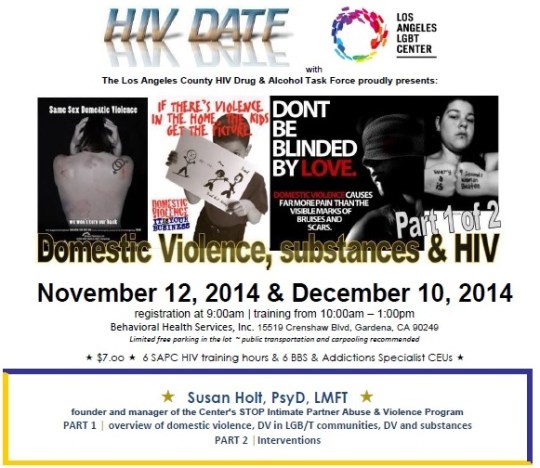
The HIV Drug & Alcohol Task Force invite you to attend our 2-part training:

Domestic Violence, Substance Use & HIV

logostrip

REGISTER ONLINE: http://hivdatf.org/2014trainings/ or complete attached flyer and fax it to 323-461-5683

Part 1 will be on November 12, 2014 and Part 2 will be on December 10th. Both trainings will be held at the BHS Training Center in Gardena. Each session will last 3 hours.

CEUs for people who work in the field of addictions, we will also offer BBS CEUs and SAPC-approved HIV training hours at no additional cost.

View original post

This is a reminder that our monthly meeting will take place on Wednesday,August 13th at 9:30am at the Village [1125 N. McCadden Place, LA, 90038.]

Here is the agenda:

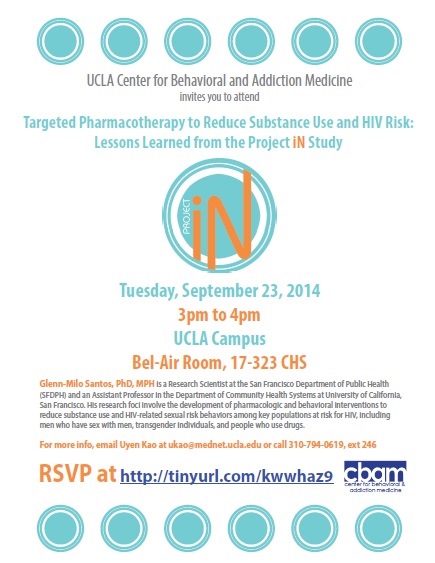
RSVP at http://tinyurl.com/kwwhaz9 | download Project In Sept 23 Flyer (pdf)

projectIN

UCLA School of Dentistry
Oral Health Care Announcement 


Access to oral health care for all people living with HIV remains a critical – and unmet – goal. UCLS School of Dentistry has been awarded Ryan White Part A funding to help meet these needs and provide comprehensive dental care at no cost to the patient.

Patients will receive diagnostic services such as exams and radiographs; preparatory work such as cleanings and removal of tooth decay; and restorative care including extractions, fillings crowns and other prostheses, and periodontal surgery. There will also be an emphasis on prevention and early detection of oral diseases by periodic oral cancer screenings and teaching patients about the importance of proper oral care.

Patient must meet certain eligibility requirements including:
• Los Angeles County resident
• A person with confirmed HIV infection
• Having income below 400% of federal poverty 
• Person having no other funding source for services
• Patients may be referred from other agencies or self-referred.

For patient screening eligibility and enrollment, please contact
(310) 794-4348

Services will be provided at:
UCLA School of Dentistry
10833 Le Conte Ave Los Angeles, CA 90095-1668

For additional information please contact:
Fariba S. Younai DDS
Professor of Clinical Dentistry
Vice Chair, Division of Oral Biology and Medicine
Phone: (310) 794-1093 Fax: (310) 825-0921
fyounai@dentistry.ucla.edu

Vanessa Porter
Part A Program Coordinator
Phone: (310) 794-4348
vporter@dentistry.ucla.edu